Guide to Protection Ratings: IP and IK

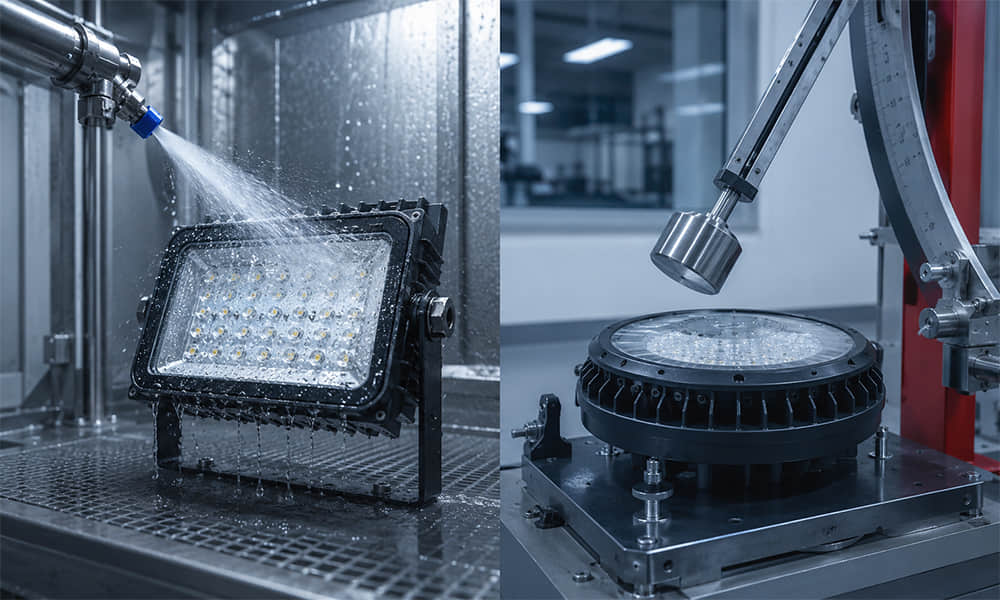
When designing a lighting system, selecting the right fixture involves more than just considering photometric performance. Especially in outdoor, urban, and architectural applications, fixtures must ensure long-term reliability by withstanding both environmental elements and mechanical impacts.

Two international standards clearly define these capabilities: the IP rating and the IK rating.

IP (Ingress Protection) rating

The IP protection rating, defined by the international standard CEI EN 60529, indicates the level of resistance an electrical device has against the intrusion of solid objects (such as dust or sand) and the penetration of liquids (water).

The code always consists of the letters “IP” followed by two digits:

  • The first digit (from 0 to 6) indicates the level of protection against solid objects.

  • The second digit (from 0 to 9) indicates the level of protection against liquids.

If one of the two parameters has not been tested or is not relevant, the digit is replaced by the letter “X” (e.g., IPX4).

First Digit: Protection from solids and dust

Digit Level of protection Detail
0 No protection The device is not protected
1 Solid bodies > 50 mm Protected against accidental contact with large surfaces of the body (e.g. hand)
2 Solid bodies > 12 mm Protected against contact with fingers. (Minimum standard for indoors, e.g. IP20)
3 Solid bodies > 2.5 mm Protected against tools and thick cables
4 Solid bodies > 1 mm Protected against thin wires and small tools
5 Dust-protected Dust may enter, but not in sufficient quantity to damage the device
6 Dust-tight Total protection against the ingress of any dust particles

Second Digit: Protection against water

directions
Digit Level of protection Detail (Typical application)
0 No protection No protection against water
1 – 2 Water drops Protection against condensation or drops at an angle of up to 15°
3 Rain Protection against water sprayed at an angle of up to 60°
4 Water splashes Protection against splashes coming from all directions
5 Water jets Protection against low-pressure water jets (e.g., a garden hose)
6 Powerful jets Protection against powerful water jets and waves (typical for exposed outdoor environments)
7 Temporary immersion Protected against immersion up to a depth of 1 meter for 30 minutes
8 Continuous immersionGrade IK (Impact Protection)


The IK rating, governed by the CEI EN 62262 standard, defines the level of protection that an equipment enclosure provides against external mechanical impacts. It is a critical parameter for lighting installed in public areas, pedestrian walkways, or urban environments, where the risk of vandalism or accidental impact is high.

The rating is expressed by the letters “IK” followed by a number from 00 to 10, which corresponds to the impact energy measured in Joules (J).

Grade IK Impact energy (Joule) Practical equivalence of the test
IK00 0 J No protection.
IK01 – IK05 < 1 J Slight impacts (installations in protected areas).
IK06 1 J A 0.5 kg mass falls from a height of 20 cm.
IK07 2 J A 0.5 kg mass falls from a height of 40 cm.
IK08 5 J A 1.7 kg mass falls from a height of 30 cm. (Good resistance for outdoors).
IK09 10 J A 5 kg mass falls from a height of 20 cm. (Excellent resistance).
IK10 20 J A 5 kg mass falls from a height of 40 cm. (Maximum resistance, anti-vandal).

Choosing outdoor lighting: For bollards, path lights, or ground-recessed fixtures installed in high-traffic areas or public spaces, an IK08 rating ensures solid reliability, while an IK10 rating is required to provide specific anti-vandal characteristics.