Guide to Photometric Quantities: Lumen, Candela, Lux, and Luminance

To translate an idea into a practical, compliant lighting design, it is essential to master the physical laws that govern how light behaves in a space. In the professional lighting sector, the performance of a luminaire and the resulting outcome on the design plane are measured using four fundamental photometric quantities.

Understanding the relationship between luminous flux, luminous intensity, illuminance, and luminance is essential for correctly interpreting photometric curves and for using lighting calculation software (such as DIALux or Relux).

Luminous Flux (Lumens – lm)

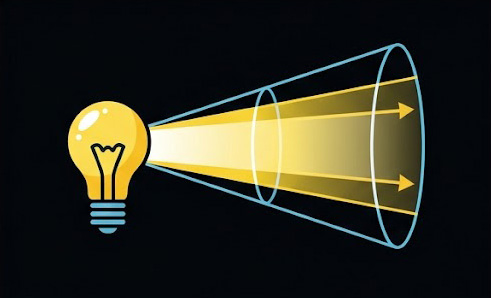
Luminous flux is the total amount of light energy emitted by a source in all directions per unit of time, weighted according to the sensitivity of the human eye. The unit of measurement is the lumen (lm).

When reading technical data sheets, it is crucial to distinguish between two values ​​that are often confused:

  • Nominal Flux (or source flux): The lumens emitted by the bare LED module alone, measured at an ideal junction temperature (e.g., Tj = 25°C).

  • Actual Flux (or luminaire output): The lumens effectively emitted by the lighting fixture, accounting for optical losses (lenses, reflectors, screens) and thermal losses (under steady-state operating conditions). This is the only reliable value to use for lighting design calculations.

Design detail: The ratio between the actual luminous flux and the nominal luminous flux determines the optical efficiency of the luminaire (LOR – Light Output Ratio). A high-efficiency outdoor luminaire minimizes internal losses, converting the maximum amount of electrical energy into useful luminous flux (lm/W).

Luminous Intensity (Candela – cd)

While luminous flux considers the total amount of light, luminous intensity measures the quantity of light emitted in a specific direction. The unit of measurement is the candela (cd).

This is the quantity that defines the “character” of the optics in a projector or bollard. Given the same total number of lumens, a very narrow-beam optic (Super Spot) will concentrate the flux into a small angle, creating a peak of very high intensity (many candelas at the center). A diffuse optic (Flood) will distribute those same lumens over a wider angle, resulting in a lower peak intensity but greater coverage.

  • Photometric Curve: Intensity measurements taken in all directions in space form the luminaire’s photometric solid; the data from this is exported into standard digital photometric files (e.g., EULUMDAT .ldt or IES formats).

Illumination (Lux – lx)

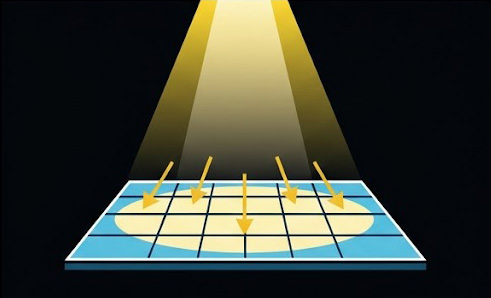
Illuminance refers to the amount of light (luminous flux) that strikes and is distributed over a specific surface. It is measured in lux (lx), where 1 lux = 1 lumen/m2.

This is the parameter most frequently used by European standards (e.g., CEI EN 12464-1 for indoor environments, UNI EN 13201 for roads, and UNI EN 12464-2 for outdoor areas) to establish the minimum amount of light required to perform specific activities or to ensure safety within a space. Illuminance decreases in proportion to the square of the distance from the light source (the inverse-square law).

Illumination Level Regulatory context / Typical application
5 – 20 lx Street lighting, night-time pedestrian paths, parking areas.
50 – 100 lx Pedestrian circulation areas, lobbies, general warehouses.
300 lx Standard offices (transit areas), reception, libraries.
500 lx Work plans in offices, classrooms, laboratories.
> 1000 lx Tasks requiring extremely high precision, operating rooms, retail display windows.

Luminance (Candela per square meter – cd/m²)

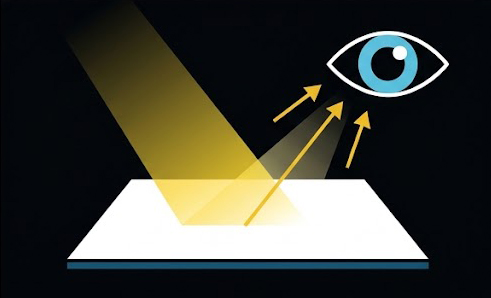
While illuminance (Lux) calculates the light that reaches a surface, luminance measures the light that bounces off that surface and reaches the observer’s eye. It is measured in cd/m².

Luminance depends strictly on the reflection coefficient of the materials: given the same amount of incident Lux, a white marble floor will have a much higher luminance (it will appear brighter) than a dark asphalt surface.

The importance in calculations: In urban and road lighting design, the UNI EN 13201 standard requires the calculation of luminance (rather than just illuminance), as it is the only metric that represents what the user actually sees. Furthermore, measuring surfaces with very high luminance—such as a direct view of an LED light source—is fundamental to calculating glare and the visual comfort of an installation.