A Guide to the Light Spectrum: The Physical Composition of Light

The white light we perceive in environments is not a single entity, but the combination of different electromagnetic radiations.
Understanding how the light spectrum is composed is the foundation for mastering the dynamics of color rendering (CRI), the absorption of colors by materials and the biological impact of lighting (Human Centric Lighting).

The Visible Range and Wavelengths

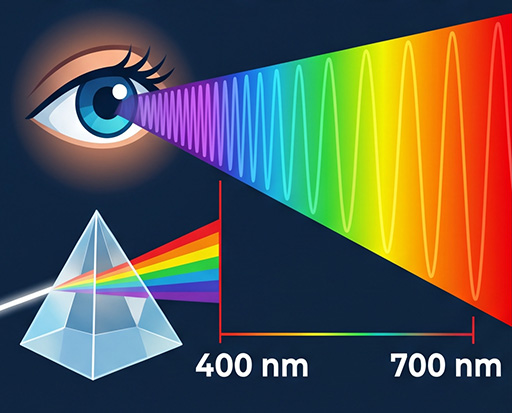
From a physical perspective, light is electromagnetic radiation that propagates through space. The human eye is sensitive to only a narrow portion of this global spectrum, called the visible spectrum.

This radiation is measured in nanometers (nm), a parameter that indicates the wavelength. The visible spectrum conventionally extends between 380 nm and 780 nm. Each specific wavelength corresponds to a pure color perceived by our visual system:

Wavelength (nm) Perceived colour Photometric characteristics
380 – 450 nm Violet / Dark Blue High energy. Fundamental for the suppression of melatonin (circadian rhythm).
450 – 495 nm Blue / Cyan Area of ​​the typical emission peak of primary LED diodes (Blue Pump).
495 – 570 nm Green Area of ​​maximum sensitivity of the human eye in daytime vision (photopic), with peak at 555 nm.
570 – 590 nm Yellow High visibility color, historically dominant in low pressure sodium lamps.
590 – 620 nm Orange Transition towards warm tones.
620 – 780 nm Red Low energy. Essential for high color rendering of skin tones (R9 value).

Continuous and Discontinuous Spectrum

The composition of the spectrum varies radically depending on the light source used, directly influencing how the colors of the architecture are rendered:

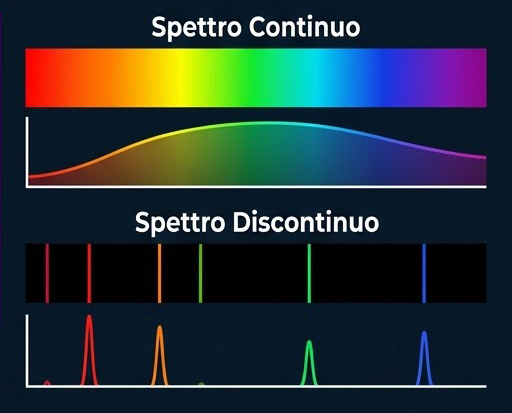
  • Continuous Spectrum: Sources such as sunlight or classic incandescent/halogen lamps emit radiation in all visible wavelengths without interruption. They guarantee perfect color rendering (CRI 100) and smooth color transitions.

  • Peak Spectrum (Discontinuous): Discharge lamps (e.g., metal halide or sodium vapor) have a fragmented spectrum, with strong emissions only in specific wavelengths and “gaps” in others. This generates significant color distortions on the illuminated materials.

The Spectrum of LED Technology

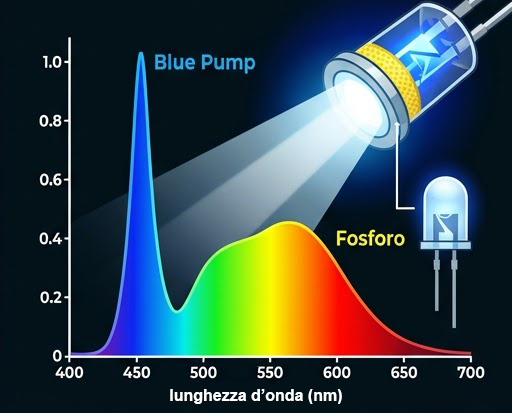
Most LED fixtures for general white lighting use the “Blue Pump” architecture. Since there is no diode capable of directly emitting white light, an LED chip that emits strong blue radiation (usually around 450 nm) is used. This chip is covered with a layer of phosphors (rare earth elements).

The phosphors absorb part of the blue light and re-emit it at longer wavelengths (green, yellow, red). The mixture of the residual blue light and the light transformed by the phosphors generates the white light spectrum.

The design detail: The quality of the phosphors is what distinguishes a high-end fixture. Higher-quality phosphors can broaden the spectrum towards 650-700 nm, “filling” the emission in the red range. This process slightly lowers the total luminous efficacy (lm/W), but it is the only technical way to achieve a CRI > 90 and a high R9, essential requirements in architectural and museum lighting design.

Beyond the Visible: Infrared (IR) and Ultraviolet (UV)

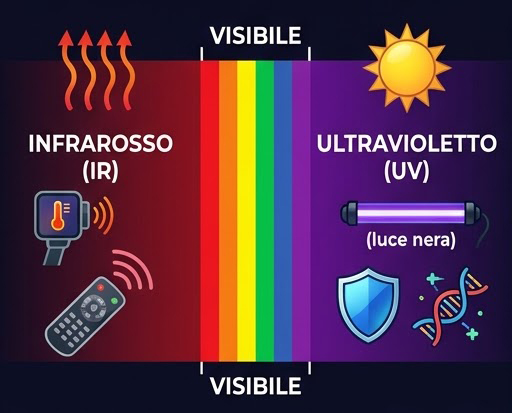
At the two ends of the visible spectrum are radiations that the human eye cannot perceive, but which have a critical impact on lighting applications:

  • Ultraviolet (< 380 nm): Very high-energy radiation. In traditional sources, UV rays are responsible for photochemical degradation and the discoloration of fabrics, paints, and artwork.

  • Infrared (>780 nm): Very low-energy radiation perceived as radiant thermal heat. In halogen lamps, much of the expended energy is dissipated in this band.

The Regulatory Advantage of LED: One of the greatest strengths of LED technology in professional lighting is the inherent absence of direct UV and IR emissions in the light beam. This makes LED fixtures safe for illuminating cultural heritage, fine fabrics, and temperature-sensitive materials, automatically complying with the most stringent museum conservation standards.